Showing posts with label picopter. Show all posts
Showing posts with label picopter. Show all posts
Sunday, April 26, 2009
Testing out the sonar sensor
Just a short video of the Maxbotix EZ0 sonar sensor hooked up to the helicopter. The code running on the Picaxe simply reduces the pulse-width to the servo by 20% if something is closer than 30cm. This is too close for actual use, but demonstrates the concept.
I was going to have a lot more to show from today, but 20 seconds after I finished filming this, the batteries in my rc controller went flat, the helicopter took on a mind of it's own, flipped over and proceeded to rip off the top rotor...

Friday, April 24, 2009
Installing the sonar range sensor
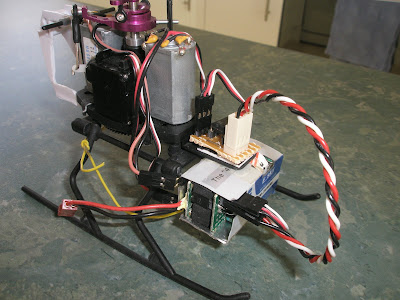
Here is a photo (click to enlarge) from the install of the sonar range sensor (the Maxbotix EZ0) and, as you can see, the sensor fits beautifully!

I moved the RC Receiver and Gyro electronics back to the position they were in when I bought the helicopter, and it has massively improved the flight stability, so I will stick with the layout that the designer's chose...
I can not wait to get cracking with the code now!

I moved the RC Receiver and Gyro electronics back to the position they were in when I bought the helicopter, and it has massively improved the flight stability, so I will stick with the layout that the designer's chose...
I can not wait to get cracking with the code now!
Monday, April 20, 2009
Shopping
 I just bought the sonar range-finder for my Heli-bot from Maxbotix.
I purchased the most sensitive of their sensors, the EZ0, for the front of my heli-bot, to test out the "autopilot" PICAXE control. This looks to be an awesome sensor, with a 1-inch resolution out to 6.5 meters! It offers either continuous or polled mode, and the sensor output is RS232, 0-Vcc or Pulse-width, all in a package smaller than a cubic inch. Full datasheet is available here. (pdf)
By the time the exchange rate and postage was taken into account, it came to about $90 AUD.
I will be giving this sensor a thorough workout when it is attached to the robot, probably less than 20mm from the front rotor's drive motor, so we can see how it behaves in an electrically and acoustically noisy environment.
Wednesday, April 8, 2009
A different project
Whilst I sort out some annoying rs232 problems with my Arduino, I have been working on a couple of little projects, one of which I can show a bit of today.
This starts with a little history. I have always been interested in flying contraptions, and a while ago, on an impulse, I purchased a LAMA V4 RC Helicopter (below).

The LAMA is a basic, easy to fly, Coaxial helicopter. Obviously, as soon as I had learnt to fly it, I started modifying it. Since then, it has been converted into a small, light-weight platform for some future robotics experiment.
...A year passes...
Now, to the present, and I will show you a video. This is the LAMA in it's current state, being flown relatively badly.
The important thing about this video is the details, specifically that I have inserted a PICAXE-08M chip in between the output of the RC receiver and the back-and-forward tilt servo on the helicopter. The point of this is to test the accuracy of the PICAXE's pulsin and pulsout commands. The program on the PICAXE simply listens for a pulse from the RC receiver's servo connector then repeats that pulse, sending it to the servo. The PICAXE is installed as shown in the following two images (click to enlarge).

The point of all this is to verify that the PICAXE is capable of accurately and quickly repeating Servo control signals. This has been verified, as the helicopter flew as well as it did before the modification, with there being absolutely no difference in the fidelity or response of the servos. Based on this, I intend to connect an accelerometer (possibly this one at Maker Shed) to this PICAXE, allowing the helicopter to maintain a steady forward/back position in space. This will be expanded to left/right as well after the accelerometer's integration is finished.
The most awesome part of this experiment is the simplicity. Anyone, with a $5 IC, can interface and interfere with the signals to an RC servo, and do so in a high-accuracy manner. Adding to this simplicity is the fact that (in this case, at least) the PICAXE is powered from the power supply to the servos, which was 5V.
The PICAXE-08M code for this example is as follows:
The circuit is simple too (click to enlarge):

I just have to name whatever it will become now. How about PICopter.
This starts with a little history. I have always been interested in flying contraptions, and a while ago, on an impulse, I purchased a LAMA V4 RC Helicopter (below).

The LAMA is a basic, easy to fly, Coaxial helicopter. Obviously, as soon as I had learnt to fly it, I started modifying it. Since then, it has been converted into a small, light-weight platform for some future robotics experiment.
...A year passes...
Now, to the present, and I will show you a video. This is the LAMA in it's current state, being flown relatively badly.
The important thing about this video is the details, specifically that I have inserted a PICAXE-08M chip in between the output of the RC receiver and the back-and-forward tilt servo on the helicopter. The point of this is to test the accuracy of the PICAXE's pulsin and pulsout commands. The program on the PICAXE simply listens for a pulse from the RC receiver's servo connector then repeats that pulse, sending it to the servo. The PICAXE is installed as shown in the following two images (click to enlarge).


The point of all this is to verify that the PICAXE is capable of accurately and quickly repeating Servo control signals. This has been verified, as the helicopter flew as well as it did before the modification, with there being absolutely no difference in the fidelity or response of the servos. Based on this, I intend to connect an accelerometer (possibly this one at Maker Shed) to this PICAXE, allowing the helicopter to maintain a steady forward/back position in space. This will be expanded to left/right as well after the accelerometer's integration is finished.
The most awesome part of this experiment is the simplicity. Anyone, with a $5 IC, can interface and interfere with the signals to an RC servo, and do so in a high-accuracy manner. Adding to this simplicity is the fact that (in this case, at least) the PICAXE is powered from the power supply to the servos, which was 5V.
The PICAXE-08M code for this example is as follows:
main:
    'read a pulse in
    pulsin 4,1,w0

    'pulse it out
    pulsout 0,w0

    'loop
    goto main
The circuit is simple too (click to enlarge):

I just have to name whatever it will become now. How about PICopter.
Subscribe to:
Posts (Atom)